
It is time for a professional NextGEN website
Your site »works«. The question is how many customers it is quietly losing in the background — and why the gap between WordPress and Next.js is wider than it first appears.
The question that comes first: WHY?
Before we talk about technology, speed or features, one question is worth pausing on: why change anything at all, if the site you have appears to work?
The answer is not that your existing site is »bad« — visually it is often perfectly fine. The answer lies in what happens behind it, in the part an owner does not usually see.
- How many visitors leave before the page has finished loading.
- How many enquiries are lost to slowness.
- What risk a site carries when it runs on plugins that are never updated.
- How much money quietly drains away each year into licences and maintenance nobody notices at first glance.
Perhaps the most overlooked part is exactly this: how many customers a company has already lost without ever learning why. »The site works« is often all an owner actually checks — they open it, see that it appears, and conclude that everything is in order. Meanwhile the enquiry form may have been failing to send messages for weeks, a particular subpage may not render correctly on certain devices, or the site may load so slowly on a mobile phone that the visitor closes it before ever seeing what the company offers. Without regular technical supervision an owner has practically no way of noticing faults like these — and each one quietly means a lost enquiry, without anyone even knowing that a loss occurred.
A poorly managed, technically neglected site does not only lose visitors directly — it loses them indirectly too, by slowly sliding down the search results. Google ranks pages on precisely the factors that give way over time on a neglected site: loading speed, technical soundness, regularly updated content. A site that has not been properly reviewed for months or years therefore loses out not only because of what breaks on it — it loses out because search engines gradually place it lower and lower, making it least visible exactly when potential customers most need to find it.
So why now? Because every month of delay is a month in which competitors who may already have taken this step build a lead that is no longer easy to close.
The difference is easiest to picture as a difference between two kinds of foundation. A real foundation is built to measure — for the size, the shape and the purpose of the building that will stand on it, and it carries exactly the loads it was calculated for. A template is something else: a pre-poured foundation, made for an average, generic building, onto which we then try to put up something that does not quite fit it. While the building is small and light it may well hold. But as the company grows, adds new functions or simply draws more traffic, it becomes clear that this foundation was never built for it at all — only for something roughly similar that was supposed to do. Next.js is a real foundation in that sense; a WordPress template is a pre-poured slab you build on for as long as it holds.
The technology few people see, but everyone feels
Most websites in Slovenia and worldwide still run on WordPress — by far the most widespread choice among all website platforms. The reason is understandable: an easy start, an enormous community, thousands of plugins for every feature you could want. But that ease has a price the user does not usually see at first glance — they see and feel it only when the page keeps them waiting, or when it simply stops working one day.
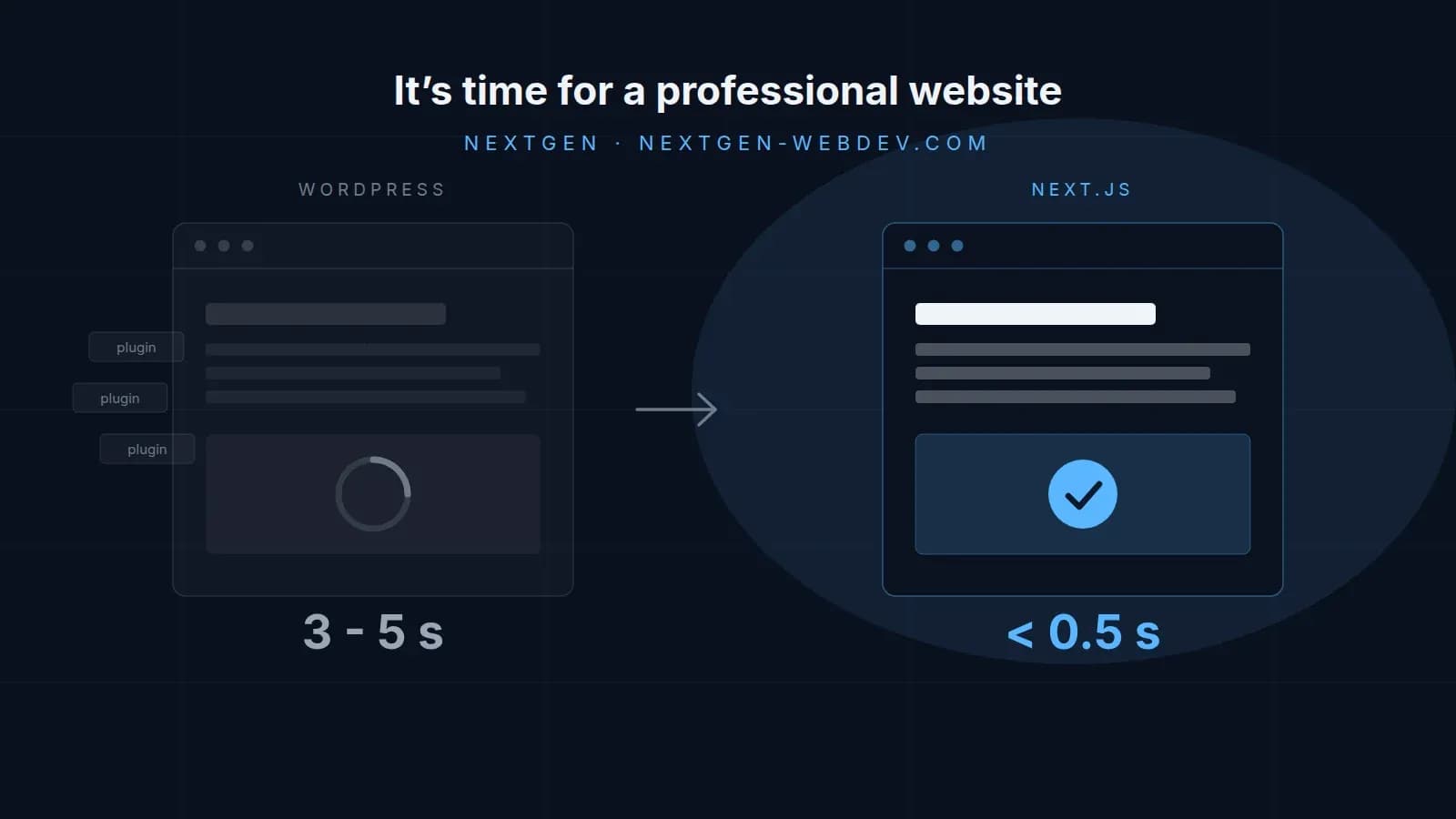
Next.js takes a different approach. Instead of assembling the page from a database, a theme and plugins on every visit, it is built in advance and served immediately, as a finished file. This is the technology behind the sites of companies such as Nike, TikTok, Netflix and OpenAI — not because it is a fashionable choice, but because it withstands loads that would slow down or bring down many another system.
Most business owners have never even heard of this technology — and that is not their fault. The deeper point is this: often the web developer does not know it either. Many website builders can only work in WordPress, because that is what they learned and what most of the market knows, not because it is a considered professional recommendation. If the developer does not command Next.js, they simply will not propose it — however well suited it would be for the client. The decision about which technology stands behind a site is therefore taken on the client's behalf rather than with them, and WordPress remains the one self-evident option, instead of one choice among several with clear strengths and weaknesses.
Speed you can measure in revenue
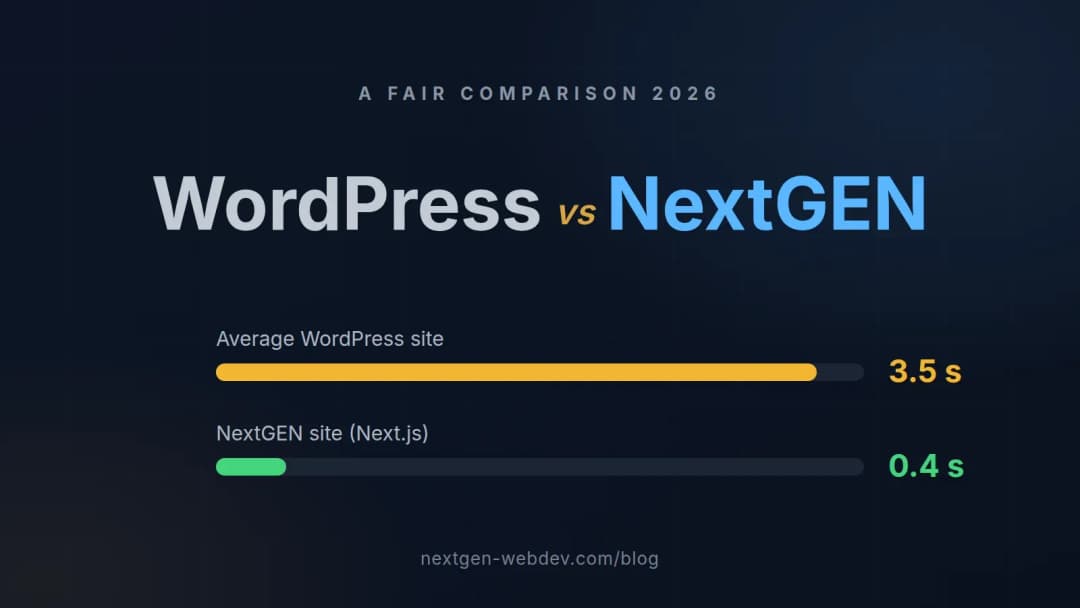
The difference in loading speed between WordPress and Next.js sites is not small. The average WordPress site loads in 3 to 5 seconds, while a well-built Next.js site cuts that to under half a second. According to independent measurements (HTTP Archive), only around 44 % of WordPress sites meet Google's standard for »good« speed on mobile devices — Next.js sites clear that bar far more often.
Why does this matter? Because speed is directly tied to revenue. Amazon found in its own analysis that every additional 0.1 seconds of load time costs roughly 1 % of sales. Other research shows that more than half of visitors abandon a page that does not load within three seconds. In practice this means a slow site is not merely losing »likes« — it is losing concrete enquiries, day after day, without the business owner ever knowing how many.
How fast is your current site, in fact? Check it free in a minute — we measure it with Google's Lighthouse, no sign-up required.
A case from practice confirms it
At one law firm that moved from WordPress to Next.js, the mobile speed score rose from 58 to 91 points, and the time to the main content dropped from 4.2 to 1.6 seconds. Organic traffic to the site grew by 94 % in the three months after the move.
Security you do not have to chase
Plugins are the backbone of the WordPress ecosystem — and at the same time its greatest vulnerability. According to Patchstack's report, more than 11,000 new security vulnerabilities were discovered in the WordPress ecosystem in 2025, 42 % more than the year before.
A full 91 % of those vulnerabilities originate in plugins, not in the system core, which is relatively secure in itself. The average time from a vulnerability being published to the first attempt to exploit it is just five hours, and almost half of all vulnerabilities can be exploited without a password or any authentication at all.
This is not a theoretical risk. An estimated 13,000 WordPress sites are broken into every day worldwide, most of them because of an outdated or unmonitored plugin. The average business WordPress site has more than 30 plugins installed — each one is another door somebody can walk through.
A Next.js site built without third-party plugins structurally does not have this kind of exposure. There is no plugin to monitor, to update, and to hope its developer patches a hole in time.
The costs that hide in the background
The price of a WordPress site on paper is often misleading, because only the system core is genuinely free. The real cost of running it appears as licences for the plugins that provide SEO, security, forms, page building or backups — if the site is equipped the way it is supposed to be. Those licences usually renew annually and, for an average business site, come to between 200 and 900 euros a year, before hosting, the domain or regular maintenance are counted in at all.
- SEO plugin licence
- Security plugin licence
- Forms licence
- Page builder licence
- Backup licence
- SEO is part of the code
- No plugins, no entry points
- Forms built in
- A site built to measure, not from a template
- Lighter load on the server
Many clients think at this point: »That is not true, my developer does not charge me for any of that.« And that is often part of the problem rather than proof that all is well. A plugin working on a site does not mean a valid licence has been paid for it — plenty of developers install plugins without ever buying the licence that would actually maintain them. Such a site is visible from the outside and appears to work normally, while behind it the plugin receives no updates, no security patches, and sometimes not even the full functionality it was meant to provide. The lower cost at the start is not saved in a case like this — it merely moves into a form of risk the client cannot see, until the day it materialises.
To this you have to add the technical debt that builds up over time:
- Every plugin added, every »quick fix« layers onto the last, until the site becomes a fragile construction that is dangerous to change.
- An outdated version of at least one plugin was present on 78 % of the WordPress sites that fell victim to a breach in 2025.
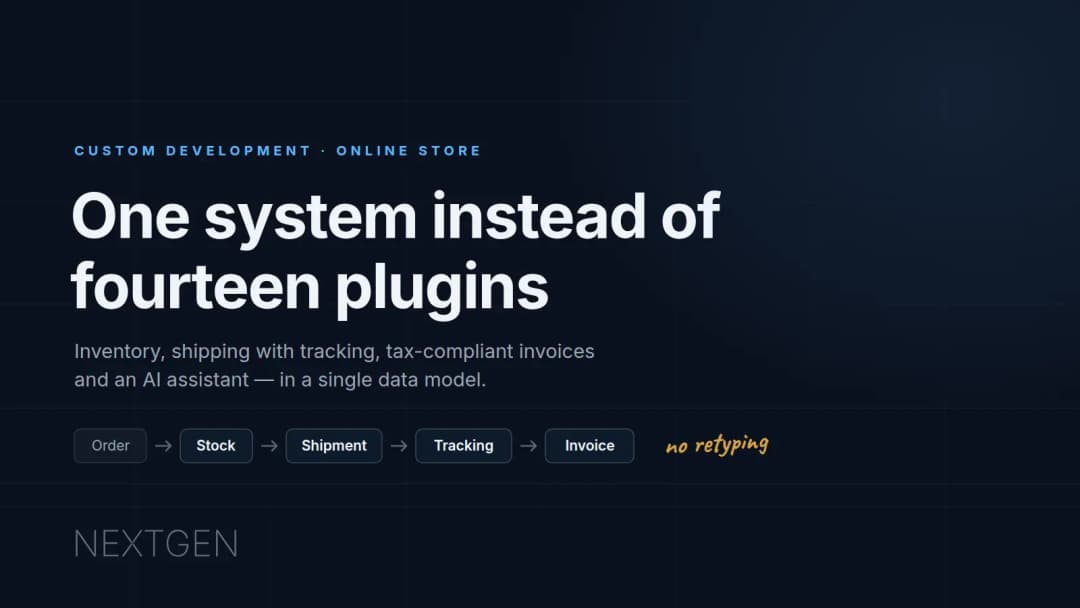
The Next.js approach carries none of these running costs. Functionality is part of the code itself, not a subscription alongside it. That does not abolish hosting costs — hosting is paid for whatever the technology — but it does markedly reduce the load on the server, since static pages do not need to be assembled from a database on every visit. What that means in numbers with us is set out in our pricing.
A smaller footprint, on the environment too
A less obvious but very real difference lies in energy consumption. WordPress and similar systems query the database and rebuild the page from its parts on every visit — which means additional processor load for each individual visit. Static, pre-built pages of the kind Next.js produces by default do not need that on-the-fly processing. Professional and academic analyses confirm that this means lower energy use per visit — which is not only the better environmental choice, but also a lighter load on the server the site runs on.
What all of this means in practice for your company
The difference between WordPress and Next.js is not merely a technical detail for developers. It translates into concrete capabilities a company can actually put to use.
Perhaps the most important difference, though, is more fundamental still, and lies in the direction the adapting runs. With WordPress the business in fact adapts to a template — a theme is chosen that already contains a predetermined structure, layout and set of features, and the company squeezes its offering and its way of working into it as best it can. With custom development in Next.js the direction is reversed: the site is built around the company, not the company around the site.
The site becomes a true digital mirror of the business — reflecting exactly how the company operates, how it wins customers and where its real strengths lie, instead of forcing it into a foreign, ready-made frame. This is one of the key things that sets this approach apart from WordPress, and the foundation on which all the capabilities below stand.
Analytics built in
Tracking visitors, conversions and the user journey is part of the design of the site itself, not an add-on that slows it down. The company knows exactly where its customers come from and which parts of the site actually lead to an enquiry.
Smart assistants
An AI chat assistant that knows the content of the site and the company's offering can answer visitors' questions 24 hours a day, steer them to the right service and capture contact details before anyone on the team even picks up.
Content the client edits themselves
Modern content management systems let you edit the site easily without any knowledge of code — about as simple as the WordPress admin, but with no plugins and dramatically less security risk.
A gamified management model in the dashboard
An active, gamified way of running the site can be built into the dashboard itself — progress in editing content and reaching goals (published news, answered enquiries, speed and visibility targets met) is shown visually, with progress bars, completed steps and milestones reached. That approach makes regular upkeep feel less like an obligation and more like something the team actually enjoys returning to — which in practice means a more regularly updated, more alive site.
Multilingual by design
For companies addressing foreign markets or tourist visitors, Next.js offers built-in support for multiple languages, each with its own SEO.
An online shop without limits
Next.js as the storefront, connected to a separate system for stock and payments, keeps its speed even across thousands of products — without the slowdowns WooCommerce often brings at that scale.
Booking systems built to measure
Instead of a generic template, a booking or ordering system can be built to match the company's working process exactly, with real-time synchronisation.
Integrations with business tools
Connecting to CRM systems, accounting software, email marketing tools or payment providers is possible without intermediary plugins that would slow things down.
Advanced SEO
Server-side rendering lets Google »see« the full content of the page immediately, which improves indexing and long-term ranking in search results.
Building a recognisable digital identity
Because the site is not assembled from a ready-made theme that thousands of other companies also use, but built to measure, it can carry the company's visual language, tone and brand in full — from colours and typography to the way the offering is presented. That is not merely an aesthetic detail: a consistent, recognisable digital presence is what makes a visitor remember the company and tell it apart from a competitor who may be using a very similar WordPress template. Every decision to build custom converts directly into brand value this way, not only into a technical improvement.
In closing: your digital foundation, not the decoration on a template
Speed, security, cost, flexibility — these are not separate questions but consequences of a single decision: which technology stands behind your website. WordPress remains a sensible choice for many, above all where the entry price matters more than long-term stability. But for a company that takes its online presence seriously — that wants the site to actually win customers rather than merely exist — the difference custom development in Next.js makes is too large to overlook.
At the heart of everything above sits a single thought:
A site is not there for the company to adapt itself to it, but to become the company's digital mirror — a precise reflection of how the business actually operates, not a compromise squeezed into somebody else's template.
Boiled down to the essentials, Next.js means:
- An advanced digital foundation — a site built on your business model, without the limits of a template and without the ballast older platforms carry.
- A digital mirror of the business — the site adapts to the company rather than the other way around, so it reflects precisely how the business really works.
- Website security — with no third-party plugins there are no entry points, which are the cause of the vast majority of breaches on other systems.
- Advanced tools built to measure — from built-in analytics to AI assistants and booking systems, built around the real business process rather than a generic template.
- A recognisable digital identity — a consistent, purpose-built presence that makes a visitor remember the company and tell it apart from the competition.
- Blistering speed — loading under half a second instead of several seconds of waiting, which shows up directly in traffic and revenue.
- Advanced SEO — the technical groundwork that lets search engines understand the site quickly and in full, and rank it accordingly.
- Energy efficiency — a lighter load on the server with every visit, which makes sense environmentally and commercially alike.
It is time for a professional website. Not because it is the current trend, but because it is the foundation everything else is built on — from the first second somebody visits your site to the moment they become your customer.
Let us find out how much your site is quietly losing.
A free technical review of the speed, security and SEO of your existing site. No obligation, an answer within 24 hours.